BEGIN:VCALENDAR
VERSION:2.0
PRODID:-//ChamberMaster//Event Calendar 2.0//EN
METHOD:PUBLISH
X-PUBLISHED-TTL:P3D
REFRESH-INTERVAL:P3D
CALSCALE:GREGORIAN
BEGIN:VEVENT
DTSTART;VALUE=DATE:20201101
DTEND;VALUE=DATE:20201201
TRANSP:TRANSPARENT
X-MICROSOFT-CDO-ALLDAYEVENT:TRUE
SUMMARY:* CLOTH IS MONEY: TEXTILES FROM THE SAHEL (Fitchburg Art Museum)
DESCRIPTION:CLOTH IS MONEY: TEXTILES FROM THE SAHEL\n\n\n\n\n October 10\, 2020 June 6\, 2021\n\nFulani weaver (Mali)\, Marriage Blanket (arkilla kerka)\, mid-20th century\, cotton and wool. Museum purchase\, Jane and Maynord Ford Collection Fund\, 2013.16. \n\nTextiles from the Sahel the southern border region of the Sahara reach deep into the area's complex past\, evoking images of camel caravans\, the trans-Saharan trade\, and the rise of great medieval West African empires. The exhibition\, Cloth is Money: Textiles from the Sahel\, illustrates the complex and timeless value of woven cloth in this region by exploring weaving techniques\, designs\, and symbols alongside the rich history and cultural context of the Sahel. \n\nCloth represents culture and wealth in Africa more than any other medium. It is an asset that not only enhances the owner's image (by literally increasing their size and adding visual interest)\, but that also converts into other goods. Historically\, cloth was money\, like cowrie shells\, iron implements\, or brass bracelets. Today\, it is still valued for its expressive qualities\, displayed during life-cycle ceremonies and as markers of status and achievement.\n\nThough made between the 1960s and 1980s in the modern countries of Mali\, Chad\, Niger\, Nigeria\, Libya\, and Tunisia\, the textiles in this exhibition have antecedents that date to the 11th century. During the medieval period\, a robust trade network between North Africa and regions south of the Sahara created vast wealth and gave rise to the most prominent medieval West African empires: Ghana (300 1200 CE)\, Mali (1230 1600 CE)\, and Songhai (1230 1600 CE). Many products\, including textiles\, drove this trade\, which\, at the height of his power\, made Mansa ("king") Musa of Mali (1280 1337) the richest man in the history of the world. There is substantial evidence that these powerful West African kingdoms were both known in Europe and considered major players in world trade.\n\nAs a fundamental facet of the economic\, social\, and cultural development of the Sahel for centuries\, textiles offer a dynamic view of the complex past and present of this region. Textiles remain the most widely appreciated art form in Africa and the Diaspora today\, a part of people's lives whether as fashionable clothing\, family heirlooms\, or aspects of their environment. As the renowned Ghanaian sculptor El Anatsui has said: "Textiles are to Africans what monuments are to Westerners."\n\nThis exhibition aligns with the field's growing interest in this region and is concurrent with two major exhibitions: Caravans of Gold\, Fragments in Time: Art\, Culture\, and Exchange across Medieval Saharan Africa now at the Smithsonian Institution's National Museum of African Art and Sahel: Art and Empires on the Shores of the Sahara now at the Metropolitan Museum of Art.\n\nThis exhibition is made possible by the generous donation of John Hutchison\, Professor Emeritus\, African Languages and Linguistics\, Boston University. It was organized by Consulting Curator for African\, Oceanic\, and Native American Art\, Jean Borgatti\, with Collection Manager\, Aminadab "Charlie" Cruz Jr.\n\nEXPLORE EXHIBITIONS LINKS AND RESOURCES
X-ALT-DESC;FMTTYPE=text/html:CLOTH IS MONEY: TEXTILES FROM THE SAHEL
\n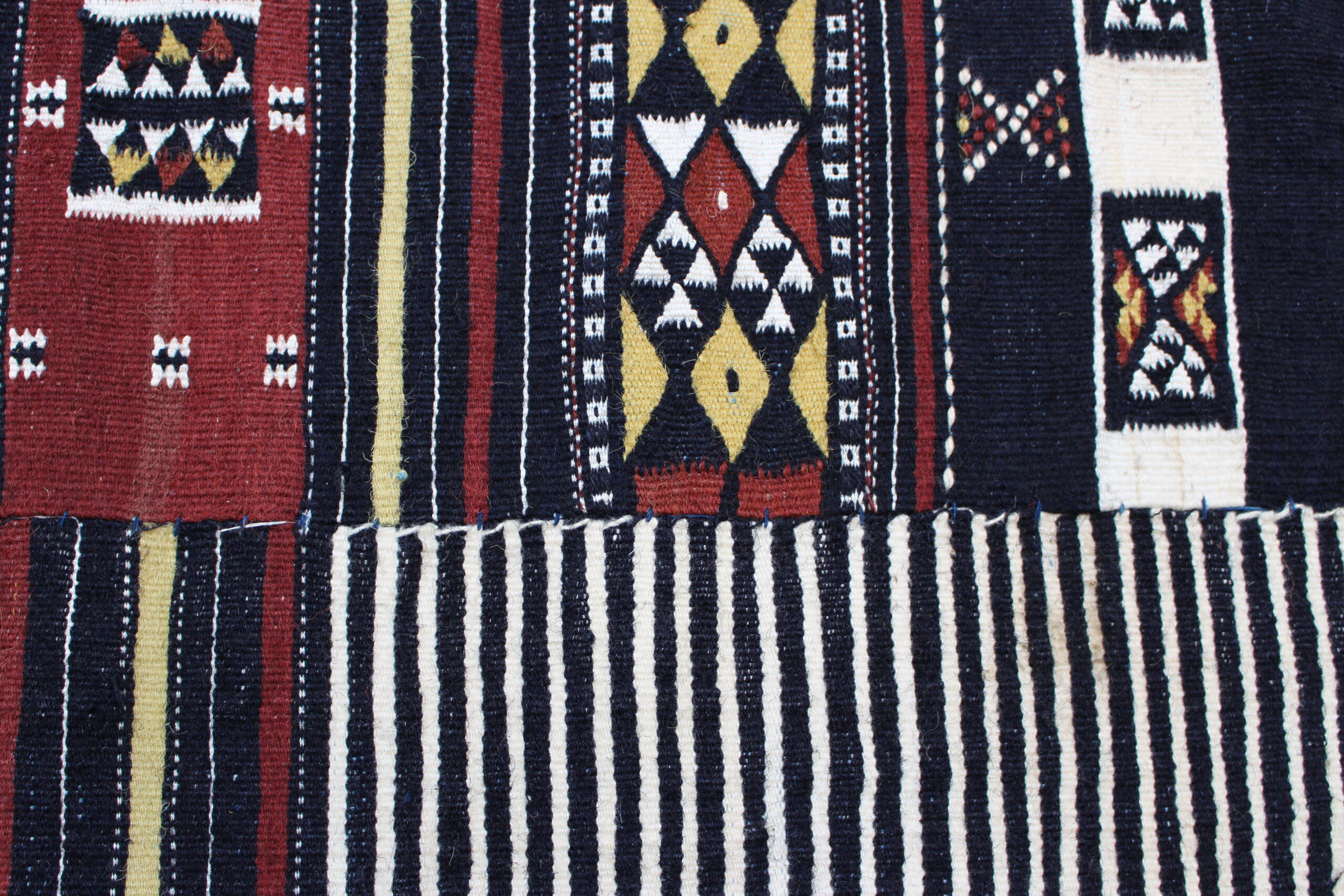 \n
\n\n
\n October 10\, 2020 &ndash\; June 6\, 2021
\nFulani weaver (Mali)\, \;Marriage Blanket (arkilla kerka)\, mid-20th century\, cotton and wool. \;Museum purchase\, Jane and Maynord Ford Collection Fund\, 2013.16. \;
\nTextiles from the Sahel&mdash\;the southern border region of the Sahara&mdash\;reach deep into the area&rsquo\;s complex past\, evoking images of camel caravans\, the trans-Saharan trade\, and the rise of great medieval West African empires. The exhibition\, \;Cloth is Money: Textiles from the Sahel\, illustrates the complex and timeless value of woven cloth in this region by exploring weaving techniques\, designs\, and symbols alongside the rich history and cultural context of the Sahel. \;
\nCloth represents culture and wealth in Africa more than any other medium. It is an asset that not only enhances the owner&rsquo\;s image (by literally increasing their size and adding visual interest)\, but that also converts into other goods. Historically\, cloth was money\, like cowrie shells\, iron implements\, or brass bracelets. Today\, it is still valued for its expressive qualities\, displayed during life-cycle ceremonies and as markers of status and achievement.
\nThough made between the 1960s and 1980s in the modern countries of Mali\, Chad\, Niger\, Nigeria\, Libya\, and Tunisia\, the textiles in this exhibition have antecedents that date to the 11th \;century. During the medieval period\, a robust trade network between North Africa and regions south of the Sahara created vast wealth and gave rise to the most prominent medieval West African empires: Ghana (300&ndash\;1200 CE)\, Mali (1230&ndash\;1600 CE)\, and Songhai (1230&ndash\;1600 CE). Many products\, including textiles\, drove this trade\, which\, at the height of his power\, made Mansa (&ldquo\;king&rdquo\;) Musa of Mali (1280&ndash\;1337) the richest man in the history of the world. There is substantial evidence that these powerful West African kingdoms were both known in Europe and considered major players in world trade.
\nAs a fundamental facet of the economic\, social\, and cultural development of the Sahel for centuries\, textiles offer a dynamic view of the complex past and present of this region. Textiles remain the most widely appreciated art form in Africa and the Diaspora today\, a part of people&rsquo\;s lives whether as fashionable clothing\, family heirlooms\, or aspects of their environment. As the renowned Ghanaian sculptor El Anatsui has said: &ldquo\;Textiles are to Africans what monuments are to Westerners.&rdquo\;
\nThis exhibition aligns with the field&rsquo\;s growing interest in this region and is concurrent with two major exhibitions: \;Caravans of Gold\, Fragments in Time: Art\, Culture\, and Exchange across Medieval Saharan Africa \;now at the Smithsonian Institution&rsquo\;s National Museum of African Art and \;Sahel: Art and Empires on the Shores of the Sahara \;now at the Metropolitan Museum of Art.
\nThis exhibition is made possible by the generous donation of John Hutchison\, Professor Emeritus\, African Languages and Linguistics\, Boston University. It was organized by Consulting Curator for African\, Oceanic\, and Native American Art\, Jean Borgatti\, with Collection Manager\, Aminadab &ldquo\;Charlie&rdquo\; Cruz Jr.
\nEXPLORE EXHIBITIONS LINKS AND RESOURCES
LOCATION:
UID:e.518.40301
SEQUENCE:3
DTSTAMP:20260507T071509Z
URL:https://business.nvcoc.com/events/details/cloth-is-money-textiles-from-the-sahel-fitchburg-art-museum-40301
END:VEVENT
END:VCALENDAR